Home | Contact Us


Posts Tagged ‘education’

Ft. Washington School Of Rock at the Ambler Auto Show

Monday, May 17th, 2010


Ft. Washington School Of Rock performing at the Ambler Auto Show. [Video / .MP4]

Students Need PA Residents Support!

Friday, October 2nd, 2009

Letter to the Editor:

The Scotland School for Veterans’ Children has been closed this current school year by Governor Rendell, due to lack of funding in our states (yet unsettled) budget.

There are two “compromised” bills awaiting review by the House & Senate, to allocate money towards this academic school year.

Gov. Rendell placed his arguments against the state financially supporting this school any longer, citing SSVC wasn’t “educationally adequate”, insofar as academic standards set by the PSSA, therefore mandating the closing of this historical educational institution.

Jean Hartman-Vargas, head of the school’s Union, appealed the Governor’s decision through news and media coverage and has, in hand, the results of the 2008-09 PSSA test scores of the school. In fact, not only did SSVC students achieve all 13 of the 13 “targets/standards” defined by PSSA, it did so in spite of the school being understaffed this particular academic year by Gov. Rendell’s mandated hiring freeze at this institution.

To learn more about this historical school and its importance to our states Dept. of Education system, please visit: www.ssvcalumni.org

I urge everyone to contact our State Representatives to support the immediate re-opening of this school, if not through our State’s undetermined budget, then perhaps by one of the two bills currently ready for review. You may do so by phone, or visit the website, “Write Your Representative Service”, at: www.writerep.house.gov/writerep/welcome.shtml

Your voice in these children’s continued education at this historical institution will make a difference in their education…and their future

That Is Chinese To Me!

Thursday, July 9th, 2009

The Chinese culture is often misunderstood by Americans. The phrase “That’s Chinese to me” is a minature version of the greater problem. When people say “That’s Greek to me” or “That’s Chinese to me”, they mean they can not understand it. Well, Americans have misunderstood the Chinese for a long time, and these days the problem persists.

A citizen of Montgomery County, PA is hoping to make a change. Lili Xiao, says:

“I have been working for the corporate business world for over twenty years helping them to succeed in China. Now I want to help our children to learn more about China not only because of China’s economic growth and the opportunities that will be presented to them, but also we know that they will be living and working in a more interdependent, more complex world. They need to learn more to be able to function, to compete in a global culture. Kids are our ultimate hope for the future. The camp I plan to run is to give kids in our area more exposure to Chinese language and culture. We will be learning by working on arts and crafts, computer and other projects instead of lecturing them.”

Learn More About China

Bacteria Wakes Up After 120,000 Years

Tuesday, June 16th, 2009

State College, PA — Scientists from Penn State (Pennsylvania State University) have revived a bacteria that was believed to have been dormant for over 120,000 years. The sample was taken from 2 miles beneath a glacier in Greenland.

Jean Brenchley of Pennsylvania State University said, “We don’t know what state they were in. They could have been dormant, or they could have been slowly metabolizing. We don’t know for sure. Microbes have found ways to survive in harsh conditions for long times that we don’t yet fully understand.”

After eleven months of slowly warming the sample, the colonies are thriving. They have been named Herminiimonas glaciei.

“We were able to recover it and get it to grow in our laboratory,” Jean said. “It was viable.”

Leader of the study, Jennifer Loveland-Curtze, said, “What’s unique is that it’s so small, and seems to survive on so few nutrients. Along with the snow, you get dust, bacterial cells, fungal spores, plant spores, minerals and other organic debris. So we postulate that it lives in these microniches in the ice. All we can say is that because ice is the best medium to preserve nucleic acids, other organic compounds and cells, the potential for finding them in these environments is quite high because of the cold. It gives us hope that if something is there, we can locate it “

Is There Life On Mars?

Thursday, April 2nd, 2009

??? ?? ????? ?? ?????

Ambler, PA — Is there life on Mars? There will be, and it will be Earthlings. At least, that is what the crowd at the Wissahickon High School was informed by Stepehen Davis of the National Aeronautics Space Administration (NASA).

Mr. Davis is the director of the Ares rocket project. In a presentation in front of the FIRST Robotics Team 341 and the general public, he unveiled for the first time computer animation of the Ares I-X test rocket scheduled to take-off this summer.

The Ares I Ares V Rockets

The Ares I Ares V Rockets: Image courtesy NASA

There are three rockets that are part of the project — the Ares I-X test rocket, the Ares I manned rocket, and the Ares V cargo rocket.

The space shuttle program will soon be shutting down. The next manned space flight is not expected to launch for five years when the Ares I is complete. This creates a delicate situation. The United States will be dependent on Russia for transporting American astronauts back and forth to the space station. [??????????? ????? ????? ???????? ?? ?????? ??? ??????????????? ???????????? ??????????? ???? ? ??????? ? ??????????? ???????.] Hopefully, relations will warm through the efforts of new U.S. administration. For instance, what would happen if we have men at the space station and Russia attacks Georgia again? There is no immediate solution to this problem; however, Mr. Davis is confident the politics and budgets can be handled to ensure a smooth transition.

The Ares program is scheduled for the test flight of Ares I-X in 2009, the Ares I manned space flight in 2015, the Ares I and Ares V to the moon in 2020, and a manned flight to Mars by 2030.

The Ares I flight in 2015 will re-establish NASA’s ability to shuttle astronauts to the space station. The Ares I and Ares V flights in 2020 are meant to start a space station on the moon. The flight to Mars is independent.

When asked what happens if the Ares I-X test flight fails, Mr. Davis replied, “It would look bad. It would look worse than it really is. We would still learn a lot.” Would there be another test flight before sending humans up? “No, There will be no other tests.”

A lot is riding on the math, science and engineering abilities of the current NASA staff, as well as, the future generation of engineers in the audience. When asked why we are going back to the moon, Mr. Davis gave a good, long list of reasons. Perhaps the best reason was his personal interest — adventure and exploration. That seemed to be the same factor motivating the youth in attendance. Maybe that is exactly what we need to forge the ingenuity necessary to best serve humankind in the years to come.
Daisy Fever Spreading Like a Weed

Saturday, March 7th, 2009

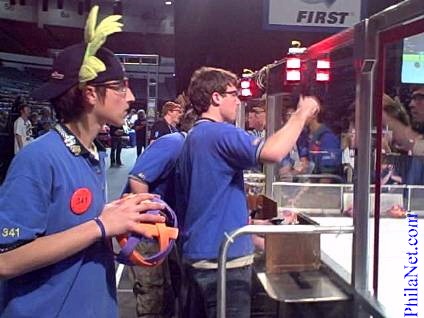
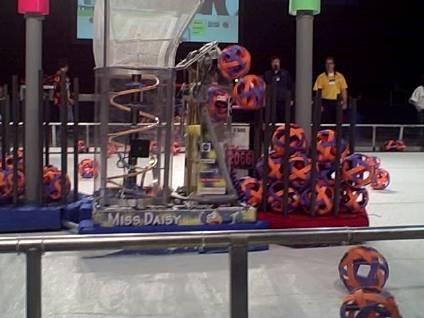
San Diego, CA — In their first trip to the Western Regional FIRST competition, the robot from Ambler, PA is breaking ground. The Ambler / Wissahickon robot, Miss Daisy, proved to be force to reckon with.

In one of the most exciting sporting events these kids have ever seen, Miss Daisy bloomed advancing through the quarter-finals and onto the semi-finals. The semi-finals looked like they might yank Daisy out by the roots. But, Daisy proved to be a wild flower moving onto the finals.

The Miss Daisy Drivers

The Miss Daisy Drivers

The finals found Miss Daisy pitted against their new friends, the Holy Cows from High Tech High, San Diego. The Holy Cows were gracious enough to arrange for a night on the town the previous evening. The High Tech High team and parents provided transportation and accommodations in Old City San Diego. By the end of the evening, the two teams became close friends. Today at the pre-qualifying matches and into the playoffs, both teams cheered each other on… up to the finals. In the finals, they found themselves on opposing alliances. That didn’t seem to hurt their fondness for each other. After all, of the 48 teams that started, only 6 made it to the finals. The way a FIRST competition works is that three schools work together on a team to form an alliance. So, in any event, Miss Daisy and the Holy Cows were destined to come in either first or second place.

Wissahickon High School, Ambler, PA Miss Daisy Team 341 Robot

Wissahickon High School, Ambler, PA Miss Daisy Team 341 Robot

The first match of the double elimination competition saw Miss Daisy in the lead. Would the Holy Cows provide the fertilizer needed for Miss Daisy to be victorious or would they eat her for lunch?

The noise and excitement of the audience filled the San Diego Sports Arena like static electricity as round two of the finals got under way. Right before the match got under way you could her the two teams wishing each other luck. That is one of the true beauties of FIRST — they teach the students “gracious professionalism” and that was quite evident today.

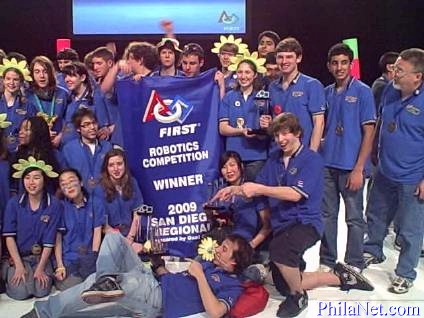
The tension mounted into what could be the last match of the tournament. The sound reached a fevered pitch. If Miss Daisy won this round, the show would be over. That is exactly what happened. The Wissahickon High School alliance came in first place. In addition, they took home the Best Website Award and the Judge’s Award. (The Judges’ Award is a special award that the Judges may give to a team that stands out. The Miss Daisy team was noted for having supported the Brazilian team. See Robots Drop Their Bolts and Go Nuts.)

A wonderful ending to the event was the Chairman’s Award. The Chairman’s Award is the most prestigious award bestowed upon a team. At the Western Regional the Chairman’s Award went to Miss Daisy’s new friends, The Holy Cows. It was an exclamation point at the end of splendid event!

The Wissahickon High School's Victory Flag

The Wissahickon High School's Victory Flag

The Complete Series
See Humans At Sea World
Lunacy: Robots In Space
The Best Entertainment Value
Robots Take Over the San Diego Sports Arena
Robots Drop Their Bolts & Go Nuts
What Would You Pay?

What Would You Pay?

Friday, March 6th, 2009

San Diego, CA — What would you pay for an experience like this? Kids from all over the place have landed at the San Diego Sports Arena to do battle with robots. The FIRST Organization offers students a unique opportunity. Plenty of parents would pay hundreds, if not thousands, of dollars for the chance that their children could participate in such a program. One of the beauties of FIRST is you do not have to be born with a silver spoon in mouth. Any child can participate. It’s not just for the elite. And, it gives you the chance to rise up and be the cream of the crop.

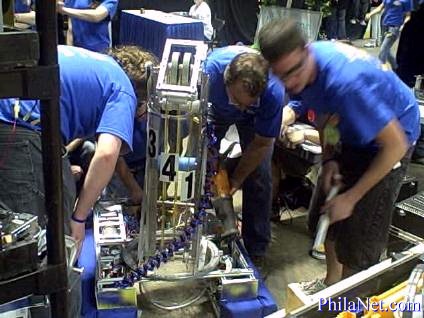
First of all, you get to build a robot. How many schools still have gymnastics teams? How many schools still offer driver education programs where the students actually get to drive? The fact is — fewer and fewer schools offer programs that are impacted by liability insurance. FIRST is a pleasant exception. Kids get to work in sophisticated machine shops, drilling aluminum, sawing steel, soldering, welding and riveting. At the same time, they are taught the importance of safety. That’s what makes it possible. That and the adult mentors that bring real-world experience into the schools. In fact, NASA has a mobile machine shop on site at the arena with their own crew of mentors. Wow!

Kids in the Pits Working on Robots

Kids in the Pits Working on Robots

That’s just the beginning. Here at the Western Regional competition in San Diego a student traveling from Pennsylvania is a fine example of some of the other possibilities FIRST has to offer. This particular student is part of the build team that works in the pits and with the machine shop. She also was an ambassador. Ambassadors are students that help promote the sport of robotics to people of all ages. They take elementary school visitors down into the pits for a close-up experience with the robots, as well as, taking adult VIPs on tours. An Admiral from the Navy, the Mayor of the city and CEO s from some of the largest corporations get to interact one-on-one with the ambassadors. How many kids get this kind of career exposure?

Who knows what other possibilities will present themselves at a FIRST event. Today, the student from Pennsylvania finished touring the VIPs and then was interviewed for fifteen minutes on the radio. TV stations were filming and writers were writing about her. How many kids get opportunities like this? How much would a parent pay for such a chance?

Should you get a chance to thank Dean Kamen, the sponsors, the mentors or the students, it would be worth your while. Just consider the wealth of their investment in our future?

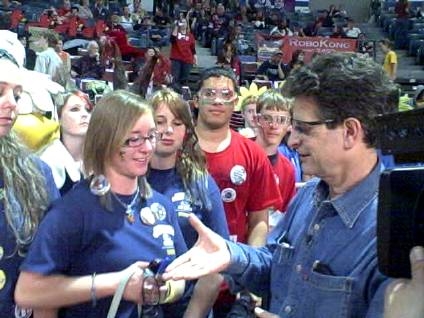
Dean Kamen In San Diego, CA

Dean Kamen In San Diego, CA

Related Articles
About Dean Kamen
FIRST: For Inspiration and Recognition of Science and Technology

Lunacy: Robots In Space
Robots Take Over the San Diego Sports Arena
Robots Drop Their Bolts & Go Nuts

Robots Take Over the San Diego Sports Arena

Friday, March 6th, 2009

San Diego, CA — Q: How can a bunch of kids take over the San Diego Sports Arena? A: With robots.

How can these kids gain the knowledge and money necessary to build robots… real robots? The FIRST Robotics foundation is the vision of world renowned inventor, Dean Kamen. Though Mr. Kamen has donated a huge amount of time and money, it is with the help of other corporate sponsors and mentors that the organization has been able to flower. In fact, at this years Western Regional competition, the robot named “Miss Daisy” was able to travel from Pennsylvania to Southern California due to the gracious professionalism of the sponsors and mentors. (Gracious professionalism is one of the principles the organization is built upon — teaching the students how to be more than just good sports.)

The Western Regional competition has several corporate sponsors that include BAE Systems and Motorola. Unfortunately for many of the schools, the current economic environment has brought about a huge decline in corporate sponsors. When asked about sponsorship, Steve Stark of the Motorola Corporation said, “The sponsors are important but it’s the mentors that really make FIRST special.” Mentors are volunteer adults that help the teams build and grow. “The mentors get to work with the kids and show them about the real world. One of the key points of FIRST are these mentors. They help educate the students about the big picture, how to make a plan, reach out to the community, get funding and build a working robot. The mentors are often adults experienced in the corporate world. People that work in fields, such as, engineering, mathematics and the sciences are hands-on with the children.”

Motorola has a Philanthropy Division that helps to fund school teams and regional competitions. Without this type of corporate stewardship, these types of programs would not be possible.

One of the teams at the Western Regional is Team 2599 the Alternative Education School of Chula Vista, CA. The school is made up of students that often have not been accepted by the traditional education system. In addition, the students usually do not have the financial support necessary to excel. FIRST robotics has helped change the life of the kids in the community. Stefania Mendizabal is a senior from Chula Vista. She said, “FIRST inspires. Our sponsors, Qualcomm, Boeing, AT&T, Best Buy, Olive Garden, The Home Depot You Auto Know, Albertsons, Goodrich, Dixieline, BAE Systems, WalMart, Vons and Dynegy have help make our team possible. Dynegy has been unbelievable. They sent out mentors to work with us.” Though it’s Stefania’s first year in FIRST, the experience has been life changing. Now, she is considering continued education and a career as an engineer, scientist or in public relations. Public relations might just be her calling. Today she pursued the job of ambassador. An ambassador at a FIRST event meets with potential sponsors, government officials and other VIPs to promote support for the FIRST organization. She also hopes to meet with teachers and students from elementary schools that will be attending the event to help spread her enthusiasm.

Dennis Jenks, the FIRST Engineering Technical Coordinator for Land and Armaments from BAE Systems, has been involved with FIRST for eleven years. Speaking with him for just a moment reveals his vigor for robotics. Because of Mr. Jenks security clearance, he was not able to discuss the details of how FIRST has impacted his own career. Fortunately, he was able to provide a living example of a completed FIRST cycle.

Mr. Jenks met Travis at the beginning of his robotics experience. Their paths crossed many time over the years. Travis joined a robotics team in high school. After graduating, he moved away to college. Life just was not the same with a robotics team. He became closer friends with a student that had been on another robotics team in high school. They both were interested in being mentors for a robotics team. The problem — there was no local high school with a team. The solution — find a school and start a team. That is exactly what they did. This caused Travis’s and Mr. Jenks paths to criss and cross some more.

Upon graduating from college, Mr. Jenks was influential in Travis being hired by BEA Systems. “Travis’s involvement in FIRST robotics was definitely a major factor in my interest in bringing him on board with BAE.”

What are a child’s chances of a prosperous career from joining the high school football team or basketball team? On the other hand, FIRST robotics has a generous supply of college scholarships and job placement.

The Best Entertainment Value

Thursday, March 5th, 2009

San Diego, CA — What can a family do for free? Not only at no cost but as great entertainment? If you have never been to a FIRST Robotics competition, come to the San Diego sports arena on Saturday… and find out! Children of all ages will be competing in a variety of events, and it is FREE to the public.

For sure, the big robots will be on the main floor with big kids taking battle in the Lunacy events. But, there will also be younger children trying to win the First Lego League (FLL) matches. FIRST and LEGO have created a “powerful program that helps people discover the fun in science and technology.” You would be amazed at what you can do with LEGOs. Also, there will be the FIRST Tech Challenge (FTC). FTC allows teams to get their feet wet with smaller robots. Teams put together robots out of modulars that look like Erector Sets. These smaller robots allow younger students to get started at a much lower expense. After all, building robots isn’t cheap, but the event is. It’s free to attend! Come out and be inspired by the youth. You’ll gain faith in the future when you see all these children have to offer.

Related Articles
Find out more about FIRST Robotics
Lunacy — Robots In Space Land In San Diego

Lunacy — Robots In Space

Thursday, March 5th, 2009

San Diego Sports Arena — The FIRST Robotics regional competition is being held at the San Diego Sports Arena. High school teams from across the country came to Southern California to compete in one of the challenges leading up to the national championships in Atlanta, GA.

We Kick Bot!

We Kick Bot!

It was unusual for the Ambler, PA Wissahickon team to make the trip to the Western Regional. But, there were also teams from Indiana, Colorado and even Brazil. That is just one of the things that makes a FIRST competition so much fun — the flixability to let kids try something different.

This year’s competitive season is based on robots competing in conditions that mimic the moon. Every year on New Years Day weekend, the FIRST orginization releases that season’s rules and regulations. NASA helps design, orginize and officiate. For this season, the floor surface and robot parts are designed to simulate 1/6 the gravity of Earth. Cleverly, the competition is called Lunacy. Normally the robots are not allowed to smash into each other. Not this year. For this season, that rule had to be relaxed due to the lack of friction. It is inevitable that the robots will collide in a crash-up-derby fashion.

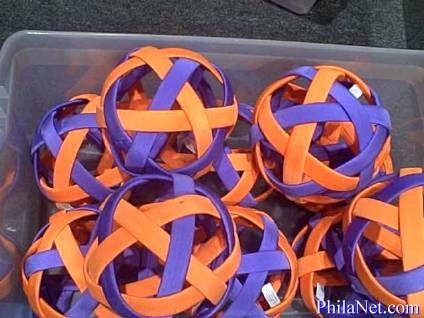
The object of the game is scoop up “moon” balls and shoot them into a goal. The goal is actually a trailer being hauled behind the oppositions robot. During the preliminaries, three high schools are randomly paired to form an alliance against three opposing schools.

The schools were given a six week build season. Then, their robots are crated and shipped to the competition location. The students do not get to see their robots until they arrive at the regionals. On the first day, teams are allowed to unpack their robots and conduct practice rounds.

video: robot up-close

Related Articles
What Is FIRST Robotics?
See Humans At Sea World
Robots Take Over the San Diego Sports Arena

Moon Balls

Moon Balls